
 The IFRS9 Expected Credit Loss (ECL) standard was put in force in 2018 as a replacement for the Incurred Loss standard. IFRS9 accounting requires banks to hold provisions for credit losses that are expected to occur under scenario projections. The amount of provisions is dependent on a staged methodology for ECL with increase of provisions for loans whose credit quality has substantially deteriorated.
Our ECL engine used for illustration of computation under the IFRS 9 framework is compounded of multiple core and satellite models e.g. Scenario generation based on econometric and expansion models, satellite models for non-core variables and PIT credit drivers. We illustrate the approach to Scenario generation below with a fully fledged ECL engine, based on a mixture of three portfolios comprising HK sectors Mortgages, CRE, Manufacturing.
IFRS 9: A Data-Driven ECL Engine for HK Portfolio Sectors - Mortgage, CRE and Manufacturing
▶ Open dashboard in full screen
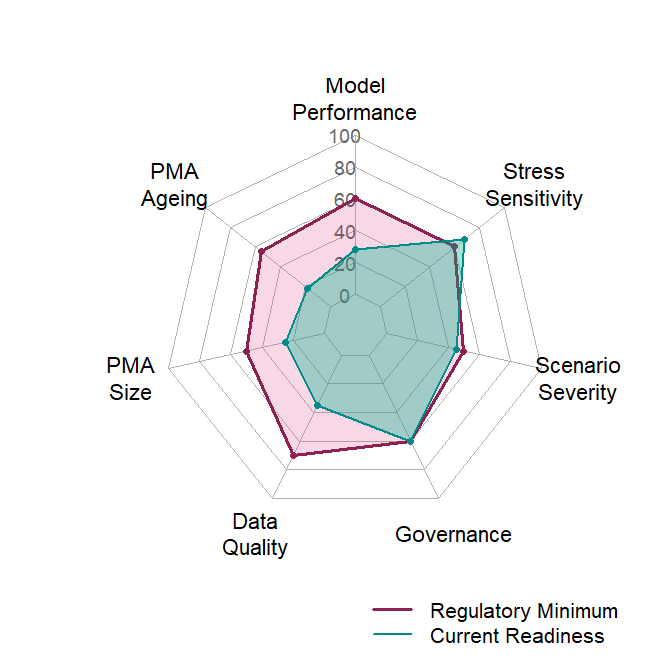
The Regulatory Readyness
-
Post Model Adjustments (PMA) Supervisors like the HKMA and the PRA expect PMAs to be temporary, evidence-based, and granular — any overuse, persistence without remediation and materiality in top-down portfolio overlays will attract challenge.
-
Significant Increase in Credit Risk (SICR) The 30-Days-Past-Due (DPD) backstop used in SICR engines should not be used in isolation, but in conjunction with forward-looking indicators. Moreover, refinancing risk; arising from borrower cliff effect as fixed-rate debt expires and refinances at higher rates; should be modelled explicitly.
-
Scrutinized Sectors and Portfolios Portfolios in vulnerable sectors — particularly Commercial Real Estate and SME lending — are subject to targeted review, with granular monitoring of debt-service-coverage ratios and covenant adherence.
-
Capture of Macro Spikes in ECL Transmission Models that smooth out macroeconomic spikes mask the non-linear effects of inflation, geopolitical volatility, and rapid interest-rate cycles on defaults. Supervisors increasingly use back-testing and transition-matrix analysis to detect smoothing: ECL that fails to move under a severe scenario is itself a red flag.
-
Supervisory Stress Testing Stress‑Testing the ECL is used as a tool in regulatory testing to examine the what if impact on capital. The standard IFRS-9 calculation already incorporates a range of scenarios with weights. However, the framework must be ready to respond to scenarios beyond the standard probability-weighted range.
-
Validating the ECL framework Model credibility under stress is demonstrated through technically sound in-house validation. Where stressed ECL diverges materially from base ECL, banks must be able to explain the divergence — this is the reconciliation test that supervisors now apply.
-
Transparent Data Lineage Data lineage in IFRS9 computations is expected to be traceable through to the ECL engine to verify timeliness and integrity of data.
The ECL Waterfall under IFRS 9
As a result of IFRS9, the IASB demised the Incurred Loss standard due to its delayed recognition of credit losses, and replaced it by the forward looking Expected Credit Loss (ECL) standard. The ECL standard is based on a forward-looking approach with a view on anticipated expected losses. Loss estimation is performed at stages conditional on the loan life cycle.
The three stages for impairments are based on changes in credit quality since initial recognition. Precisely, a loan is being classified impaired if the institution deems it unlikely to collect the full amounts on pricincipal and interest. The stage-2 categorization is based on the institution's definition of a significant increase in credit risk (SICR). This commonly includes regognition of loans 30+ days past due and loans that defaulted in the past 12 months since reporting. Other indications for SICR include a significant change in propability of default since origination (initial recognition). However, IFRS-9 is not defining a 'significant increase in credit risk' and institution need to decide on their own SICR criteria.
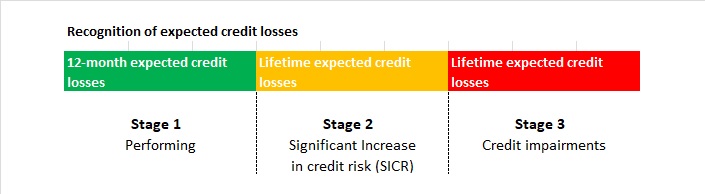
Stage 1 includes all securities with low credit risk at reporting date and where no significant increase in credit risk (SICR) has been observed since initial recognition. Expected Credit Loses (ECL) are calculated for 12-month horizon after the reporting date. Interest income is calculated on gross-carrying amount (without any deduction of credit allowance).
Stage 2 includes all securities with significant increase in credit risk (SICR) but without any recognition of impairment. Expected Credit Loses (ECL) are calculated for expected lifetime of security after the reporting date. Interest income is calculated on gross-carrying amount (without any deduction of credit allowance).
Stage 3 - includes all securities with recognition of impairment at reporting date. Expected Credit Loses (ECL) are calculated for expected lifetime of security after the reporting date. Interest income is calculated on net-carrying amount (with any deduction of credit allowance).
NB: Given lifetime differs across security types, e.g. amortizing vs. bullet, a common approach to computation is to partition the lifetime into a time grid and to compute unconditional forward probabilities of default from the PD term structure.
The Staging and SICR
Identification of significant increases in Credit Risk (SICR) as a result of monitoring and computation moves stage-1 credit risky assets to stage-2. Various PD based metrics to identify SICR can be used. A common characteristic is the increase in credit risk relative to the origination time, e.g. Lifetime PD has increased by ≥ 100 % (doubled) or 12‑month or lifetime PD has increased by ≥ X basis points.
\[ PD_{t} / PD_{0} -1 > \gamma \]
Qualitative triggers are designed to capture credit deterioration that PD models miss such as forbearance (payment moratorium), covenant breach, adverse change in business or market, distressed restructuring, increase in credit spread.
In addition, a backstop trigger of payment overdue greater than 30 days must be used.
The IFRS9 Pipeline
The Measurement of ECL
The IASB’s guidance on ECL is based on principles and institutions have to choose methods fitting to their organisational capacity. ECL requires the estimation of lifetime losses over the remaining life of an asset using supportable forecasts of economic conditions. The PD term-structure (for cumulative PD and forward PD for each rating class) are computationally adapted to the outcome of the macro scenarios.
The measurement of ECL at stages 2 & 3 is conditional on the recognition of any significant increase in credit risk. Losses are projected over the remaining lifetime of assets. Obviously, any change in measurement from the one-year ECL to the Lifetime ECL will impact on the income statement.
An important modelling decision faced by risk management teams is the selection of plausible scenarios. Probability weighted computations of losses are required across multiple scenarios. Also, the input of macro factors to the ECL estimation may require long-range scenarios that capture mean reversion.
Moreover, an adjustment of the Basel PD is required before the PD can be used to input ECL calculations. Precisely, the regulatory PD is a through-the-cycle (TtC) PD and therefore less sensitive to changes in economic conditions. By contrast, the PD used to input ECL is a point-in-time (PiT) PD.
Goven the purpose underlying provisisioning, Loss calculations under IFRS 9 differ from Basel calculations. Current and projected economic conditions are taken into account for ECL computations, but not for Basel computations. Finally, the Basel capital is adjusted for shortfalls in provisioning by deducting any shortfall from the tier 1 capital.
The Impact on Capital Ratios
Having insight into the dynamic of IFRS9 ECL provisions on capital ratios enables banks to be aware of situations where capital ratios decrease below the required threshold level. The Capital Requirements Regulation (CRR) defines the amount of capital withheld to satisfy the requirements on capital ratios.
The calculation of capital ratios is dependent on the amount of provisions held to satisfy IFRS9 requirements. Common Equity Tier 1 (CET1) and Total Capital ratios are negatively influenced by provisions held.
The Differences between Basel IRB and IFRS9
The IFRS 9 approach to quantify prqovisions based on Expected Credit Loss requires suitable PD, LGD and EAD parameter. Basel IRB parameter are not immediately suitable for use under IFRS9 however. A comparision of IFRS9 to Basel IRB is listed In the table shown:
| Basel IRB | IFRS 9 |
|
|
|
|
|
|
|
|
|
|
|
|
|
|
|
|
|
|
|
|
|
|
|
|
© 2026 Auriscon Ltd. No reproduction without permission. Short excerpts with attribution permitted.